10 Questions to Ask Financial Advisors
Are you asking the Right Questions?
NerdWallet – 10 Questions to ask Financial Advisors.
1. Are you a fiduciary?
Yes
A fiduciary works in the best interest of the client.
I am a CERTIFIED FINANCIAL PLANNER® professional and an Investment Advisor Representative (IAR). At all times when providing Financial Advice to a Client, I must act as a fiduciary, as I am legally and ethically bound to act in the best interest of the client.
*Certified Financial Planner Board of Standards Center for Financial Planning, Inc. owns and licenses the certification mark CERTIFIED FINANCIAL PLANNER® in the United States to Certified Financial Planner Board of Standards, Inc., which authorizes individuals who successfully complete the organization’s initial and ongoing certification requirements to use the certification mark.
2. How do you get paid?
Most of my accounts are advisory accounts. For advisory accounts I get compensated by an Asset Under Management (AUM) Fee. The AUM Fee I charge is comparable to the common standard industry fee of about 1% for accounts under one million.
For many of my P&G clients who want to hold some of their P&G stock long-term from their ESOP Plan, I utilize a brokerage account and don’t charge an AUM Fee since that usually is the most appropriate account for simply holding their stock.
3. What are my all-in costs?
In addition to the Asset Under Management Fee listed above, there are underlying costs of the various ETFs and Mutual Funds themselves, which charge their own internal expenses
4. What are your qualifications?
CERTIFIED FINANCIAL PLANNER® - widely considered the “gold standard” for financial Planning.
Certified Public Accountant – CPA with deep expertise in tax planning. As a financial advisor, I can’t give specific tax advise but I can provide general tax planning strategies. I work with other outside CPAs and my own separate tax practice to coordinate various tax strategies.
Personal Financial Specialist – PFS™ is granted exclusively to CPAs with tax expertise and comprehensive knowledge of financial planning. All areas of financial planning have tax implications. I have held this credential since 2002. Per review of PFS™ directory, I still appear to be the only PFS™ in Wyoming County, Pennsylvania as of 2025.
5. How will our relationship work?
I strive to build relationships based on trust and communication. I believe in the “Golden Rule” to treat others like you would like to be treated.
I start with understanding your current financial situation, learning what your goals are, creating a personalized financial plan, and monitoring your plan. I aim to maximize the probability of you reaching your goals.
I usually meet my clients in person at least once a year to review their accounts and more often for newer, larger or more complicated situations. I also usually communicate, by Zoom or telephone calls, with my clients throughout the year when I feel changes should be made. I take pride in educating my clients.
"What do my current clients think of our relationship?"
Client Testimonials
6. What is your Investment Philosophy?
My investment Philosophy is rooted in goal-based planning, risk management, diversification, long-term perspective, tax planning and most importantly, making you feel comfortable with and believe in my investment philosophy.
*Investing involves risk, including the potential loss of principal. No investment strategy can guarantee a profit or protect against loss in periods of declining values. There is no guarantee that a diversified portfolio will enhance overall returns or outperform a non-diversified portfolio. Diversification does not protect against market risk.
7. What Asset Allocation do you use?
The asset allocation strategy is based on each client’s goals, time horizon and risk tolerance. I am also supported by LPL Financial, the #1 Independent Broker Dealer in the United States* I incorporate some of LPL Financials tactical recommendations into my asset allocation strategies.
*As reported by Financial Planning magazine, 1996-2025, based on total revenue.
Asset allocation does not ensure a profit or protect against a loss.
8. What investment Benchmark do you use?
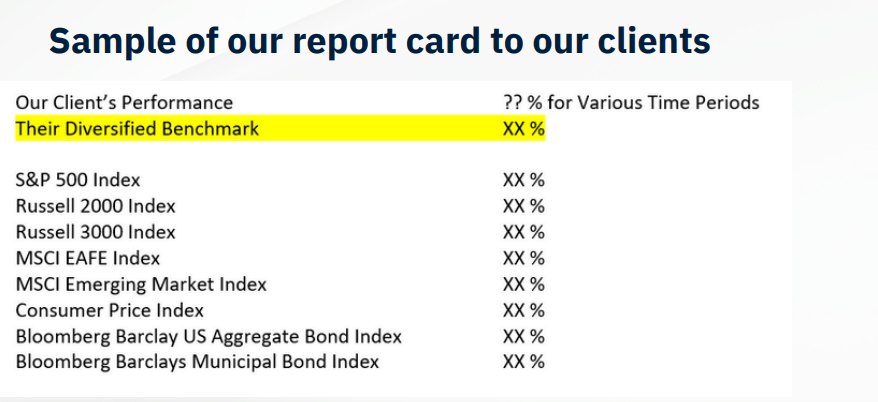
For advisory accounts, we are required to provide clients with either the performance against various Indexes or your Diversified Benchmark. I believe in transparency and provide both to my clients.
9. Who is your Custodian?
I use LPL Financial as my broker dealer and custodian. As perviously mentioned, LPL is considered to be the #1 independent Broker Dealer in the United States, as reported by Financial Planning magazine, 1996-2025, based on total revenue.
10. What tax hit do you face if I invest with you?
Tax planning is my specialty. I work with clients outside CPAs and other tax preparers or my separate outside CPA tax practice. Here are just a few of the tax planning strategies my clients utilized:
- Net-Unrealized Appreciation of Employer Stock -PG clients (*)
- Roth Conversions - to “fill up lower tax brackets”
- Roth Conversions – by asset class
- Tax Gain Harvesting - when 0% capital gain rates apply
- Tax Loss Harvesting
- Qualified Charitable Distributions
- Gifting Appreciated Securities
- Low turnover Index ETFs or funds
(*) = When I started meeting P&G retirees back in 1997 in 1998, none of the individuals I met with considering retiring from the P&G Mehoopany Plant ever were presented with using this tax strategy, until I informed and educated them.


